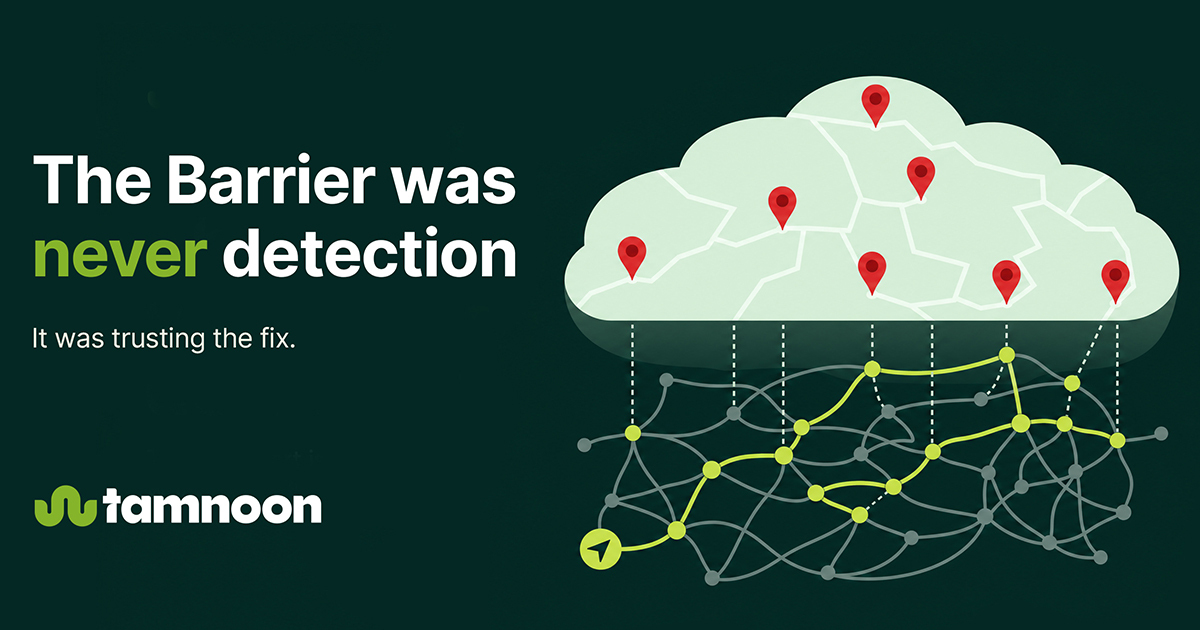
Cloud security does not struggle because teams lack visibility, but because no one clearly owns what happens after risk is found.
Cloud security does not struggle because teams lack visibility, but because no one clearly owns what happens after risk is found.
Most organizations can identify misconfigurations, exposed assets, and vulnerable identities within minutes. CNAPPs and cloud security tools surface risk fast and at scale. But then:
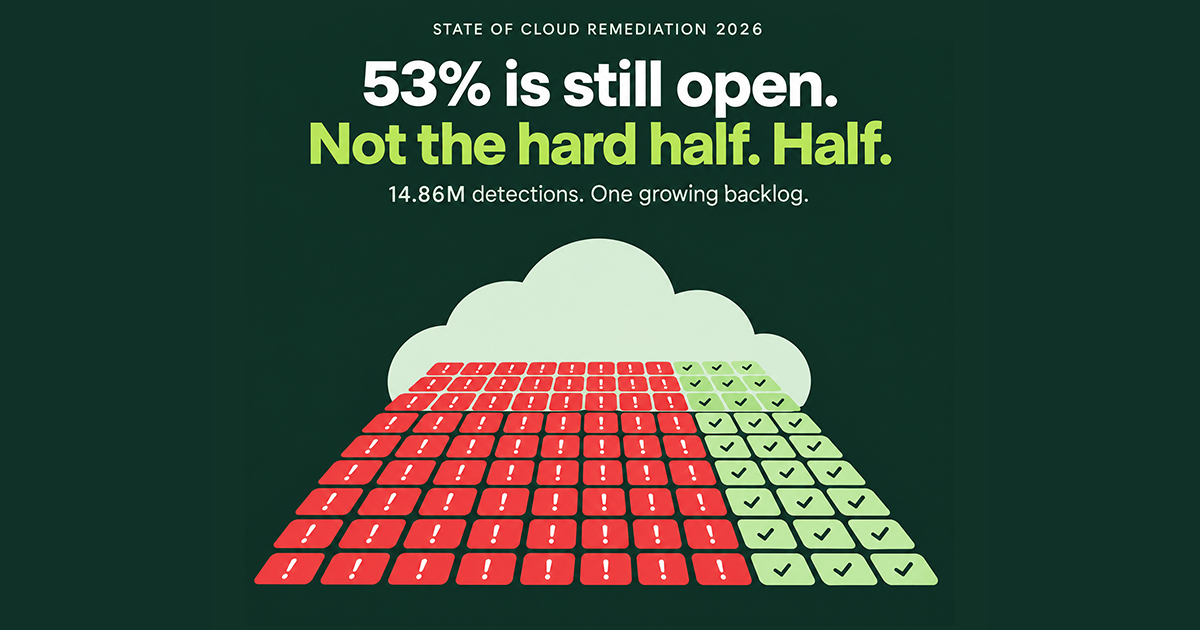
And then the same risks sit open for months.
Sure, security finds the issue, infrastructure owns configuration changes, and developers own code changes, but somewhere between those handoffs, remediation stalls, ownership fades, context is lost, and risk remains.
This creates a dangerous illusion of safety for most companies because attackers don’t care that risk is documented. They only care about what’s still exploitable.
Safe remediation is the real work.
Learn more about what safe remediation is, two common leadership-driven remediation models that define ownership, how different cloud security signals demand different owners and timelines, and what happens when organizations never invest in fixing the conditions that make incidents inevitable.
Cloud remediation isn’t “closing a finding.” It’s changing production safely. That requires a production impact evaluation before you suggest a fix or build a remediation plan:
When that evaluation happens after the handoff, engineering has to rebuild context from scratch, and remediation slows down. When it happens before the handoff, fixes can be executed quickly and safely.
At the center of this problem is a question most teams never answer directly: Who actually owns cloud remediation?
The answer is rarely found in a tool, a ticketing system, or an org chart. It’s shaped by the leadership mindset and the remediation model that mindset creates.
How an organization handles cloud remediation has very little to do with its org chart and much more to do with how security leadership defines success.
Leadership mindset determines whether remediation is treated as someone else’s problem or as unfinished security work. From that mindset, a remediation model naturally follows.
This leadership style views security’s primary responsibility as visibility. The job is to surface risk, document it, and ensure it is communicated to the right teams.
In this model, remediation is assumed to begin once a finding is reported. In reality, reporting often starts a new cycle of re-investigation because the work arrives without enough context to act safely.
Security tools generate alerts and findings, issues are logged into ticketing systems, sent to infrastructure or development teams, and tracked for compliance or audit purposes, and from there, “ownership” effectively transfers downstream.
Security steps back because infrastructure teams must re-investigate the issue, assess the blast radius, and determine whether a fix is safe. Developers get pulled in late, often without context, and are asked to interrupt planned work to address security concerns they didn’t create.
This is where teams get it wrong: You can’t throw an alert into someone else’s court and expect resolution.
A raw finding is not a work plan. If the receiving team has to figure out whether it’s real, whether it’s exploitable, what could break in prod, and how to roll back a change, you haven’t handed off remediation, you’ve handed off ambiguity.
Ownership quickly becomes fragmented because security “owns detection,” infrastructure “owns the environment,” and developers “own change,” but no one owns the outcome.
This leadership style defines security success by risk reduction, not visibility alone. Detection is only the first step. Remediation is not considered complete until the issue is safely fixed and verified.
In this model, security owns remediation readiness. Findings are not simply forwarded. They are prepared, signals are correlated across tools, and root causes are identified so fixes address why the issue exists, not just what triggered the alert.
And critically: security doesn’t just prioritize, it de-risks the fix.
That’s because “safe” is not a slogan, but rather a gate you pass before asking engineering to act. This includes:
When work is handed off, it arrives with context. Infrastructure and DevOps teams receive scoped, prioritized issues with clear remediation paths. Developers are pulled in only when necessary, and with enough context to act quickly.
Ownership is explicit:
This model produces very different behaviors:
Most importantly, the organization stops living in constant response mode. Stability becomes achievable because risk is addressed before it turns into incidents.
Cloud remediation fails when “collaboration” means forwarding tickets and hoping the right person picks them up.
It works when teams share ownership of the outcome, not the task:
This is joint ownership where every team owns their lane, and everyone owns closure.
Ownership in cloud security often feels clear in the first few hours of an incident. Someone is on call, decisions happen quickly, escalations are direct, and accountability exists because the impact is immediate.
During active incidents, ownership is forced by urgency. Teams know who is responsible because the cost of delay is obvious. Response paths are well understood, and decisions are made with little debate.
This creates a misleading sense of control. It makes organizations believe ownership is well defined when, in reality, it only exists under pressure.
Once a finding leaves the incident window and enters days or weeks, it competes with everything else. Backlogs grow, context thins out, and remediation becomes something to revisit later.
In report-first environments, this is where issues stall. Findings are handed off early and left largely unrefined. Security logs the risk and moves on, while infrastructure and DevOps inherit unclear work that requires re-investigation before anything can be safely fixed.
In outcomes-driven environments, time is treated as a risk multiplier. Security invests effort early while context is still intact and findings are correlated, scoped, and prioritized with safety in mind before they enter longer remediation cycles.
By the time issues stretch into days or weeks, ownership is already clear and execution-ready. Teams are not debating what to fix or why. They are focused on how and when.
Cloud security signals demand very different response timelines. For example:
Leadership decides whether this complexity is acknowledged or flattened. When everything is treated the same, urgent issues wait too long, and preventive work never happens. Organizations remain stuck reacting to what is loudest instead of reducing risk systematically.
Cloud security breaks down when organizations treat all risk signals the same. Different signals represent different kinds of danger, move at different speeds, and require different owners.
Understanding who owns remediation starts with understanding what kind of signal you’re dealing with.
Response is fast and decisive. The challenge shows up after containment and detections point to root causes, but deeper remediation is deferred. The incident is contained, but the conditions that enabled it remain and get reused later.
Ownership breaks down when detections are treated as work items instead of signals requiring refinement. False positives dominate, analysts burn out, and real threats hide in the noise.
The challenge is rarely the intelligence itself. It’s tying external behavior to internal reality fast enough to act.
The problem here is volume. Prioritization becomes guesswork, backlogs grow, and everyone agrees the issues are risky, but no one owns closing them safely end-to-end.
Because posture issues don’t feel urgent, they’re perpetually deprioritized, even though they enable the worst incidents.
Long remediation timelines are not caused by slow tools or inattentive teams. They are the cumulative result of ownership gaps compounding over time.
Industry research consistently shows organizations take 200+ days to identify and contain a breach. That reflects how long risk is allowed to exist in production environments before it is fully addressed.
So where does the time really go?
Cloud remediation breaks down when ownership is shared vaguely. It scales when ownership is explicit, repeatable, and aligned to how teams already work.
A practical model does not require reorganizing teams or adding layers of process, but instead, a clear responsibility at each stage of remediation with no ambiguity about who owns closure.
Here’s what that looks like:
This model works because it respects existing expertise while removing friction. Each team stays in its lane, but ownership is never unclear. Work flows forward instead of bouncing between groups.
Cloud security breaks down in the same place again and again because risk is detected quickly, but ownership fades before remediation is complete. Findings move through teams without clear accountability, context is lost, and known issues remain open far longer than they should.
Our 2025 State of Cloud Remediation Report found that critical cloud security alerts take an average of 128 days to remediate. That is months of known exposure, not because teams are unaware, but because ownership between detection and execution is unclear.
Closing that gap requires visibility and a remediation model where security owns readiness and safety, infrastructure owns execution, and governance owns proof. Ownership must be explicit, repeatable, and built into how work flows, not dependent on urgency or heroics.
Tamnoon helps organizations put that model into practice by preparing remediation work early, surfacing root causes, and ensuring fixes are safe and actionable, enabling teams to move from reporting risk to reliably reducing it.
Ready to move beyond detection and turn findings into measurable outcomes that improve your security posture? Book a demo to see how Tamnoon closes the gap in cloud remediation.