Smooth remediation requires meticulous coordination across tools, teams, and schedules. The complexity and scale of the remediation process may suggest that only a manual or an automated process can deal with it.
Smooth remediation requires meticulous coordination across tools, teams, and schedules. The complexity and scale of the remediation process may suggest that only a manual or an automated process can deal with it. Ideally, an organization can leverage the best of each process where appropriate. With so many different dimensions to coordinate, intricate planning and cross-functional excellence is critical to be successful.
Additionally, integrating security checks into CI/CD pipelines is an important part of execution, allowing you to catch vulnerabilities early in the development lifecycle before they reach production.
Your security and DevOps teams must work hand-in-hand during this process. And while each team has their distinct domains, they also have shared goals to safeguard data and maintain uptime, meaning that a tight partnership is paramount.
This collaboration does not always come easy. Some common scenarios that can strain relations and undermine progress might be:
Nevertheless, it’s critical that security and DevOps teams develop a common “language” to achieve their shared goals, which include:
By regularly communicating their priorities, constraints, and risks from both perspectives, and emphasizing their unified mission, DevOps and Security can align on the best approach to streamline remediation while minimizing disruptions. The organizations that have been most successful at bridging the security/DevOps gap follow a framework like the one below for disambiguating roles and forging common ground.
| Team | Role and required inputs | Key questions to ask counterparts |
| Security |
|
|
| DevOps |
|
|
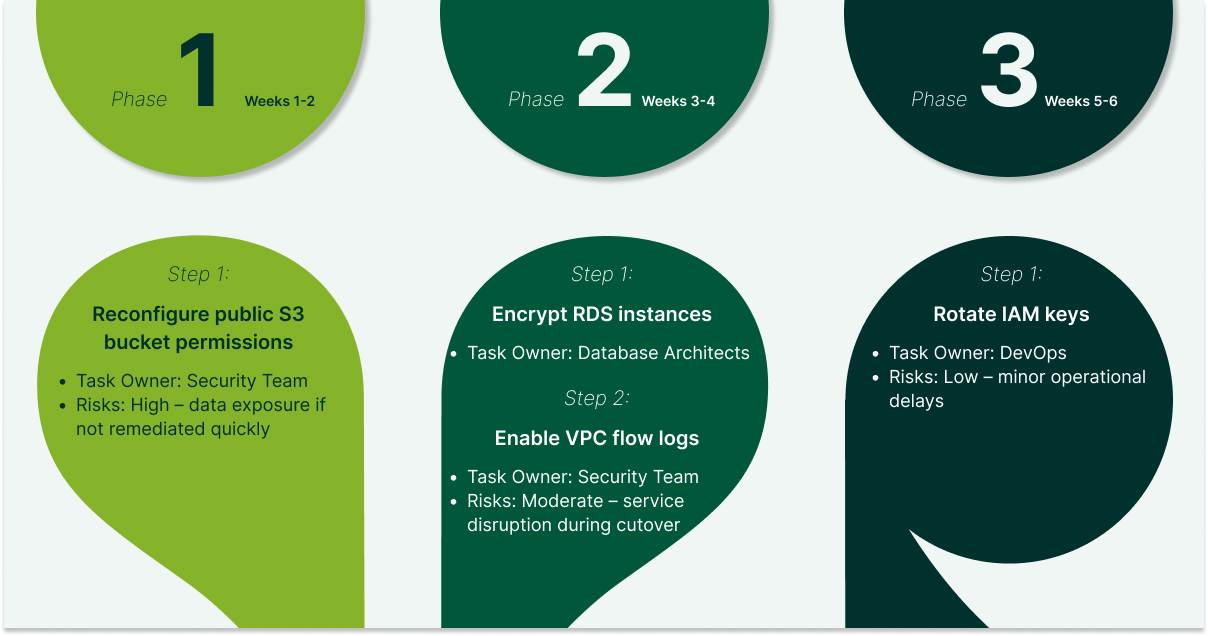
Smooth execution requires a detailed plan mapping out phases, steps, timelines and responsibilities:
It’s crucial that security and DevOps teams collaborate closely on constructing this plan. Security provides expertise on managing risk and prioritizing assets while DevOps offers insights on the potential impacts of any changes made.
With both perspectives, the plan can sequence remediation intelligently by starting with high-risk, mission-critical items before moving towards low-impact items. For example, addressing improperly configured S3 buckets exposing sensitive data in phase 1 before rotating IAM keys in phase 2. By tackling high risk issues first, well-planned remediation systematically strengthens security posture while minimizing disruptions through incremental progress.
In this sample plan, security teams have identified a high-risk misconfiguration; open-access S3 buckets which expose sensitive data. Unencrypted RDS instances are generating a moderate risk, threatening a service disruption during cutover. Lastly, IAM keys need to be rotated, which could cause minor operational delays if left undone.
Intelligent remediation prioritizes the reconfiguration of S3 bucket permissions; AWS-authenticated threat actors can read, write, and manipulate objects within the bucket, creating a high-severity risk to the asset and the business.
Armed with guidance on prioritization, the remediation team plans three 2-week sprints to tackle these misconfigurations.
During these six weeks, Security and DevOps should meet weekly to review:
Security and DevOps should also have contingency plans ready to adapt to changes in the remediation plan. To handle plan deviations:
Remediation should integrate security checks into existing CI/CD pipelines early to catch issues before they reach production. Scrambling to fix problems right before deployment creates unnecessary risk and delays.
Shifting security left in the pipeline provides multiple touchpoints to rapidly surface and resolve vulnerabilities at each stage of the development lifecycle.
Key techniques include:
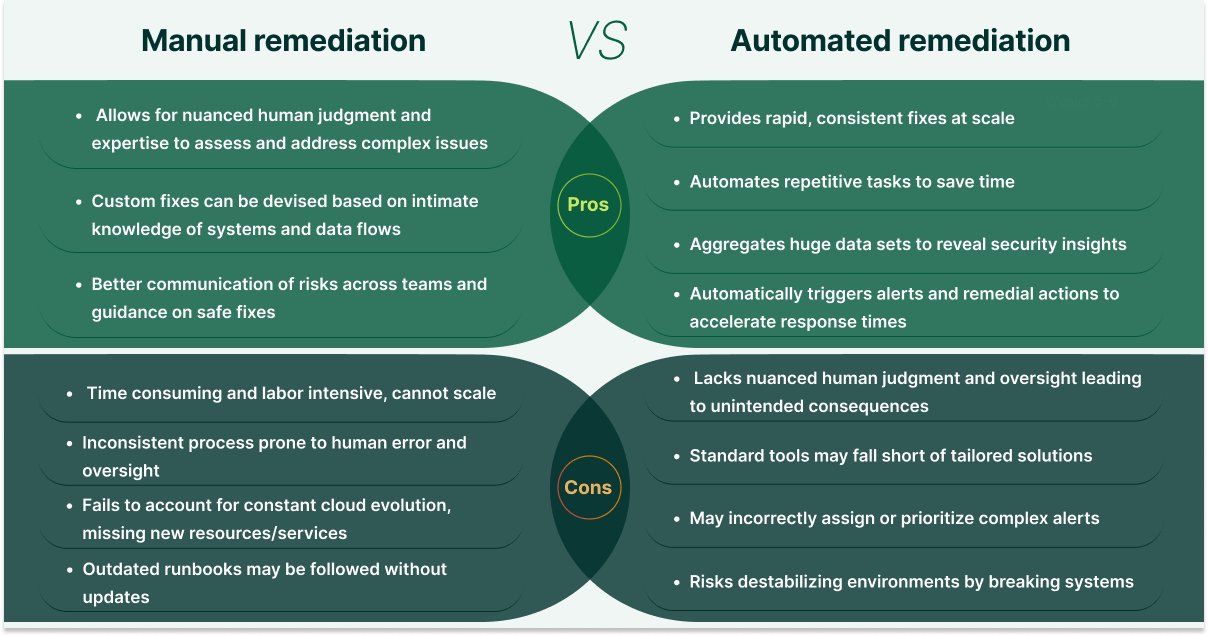
Finding the right balance between manual and automated approaches is crucial for effective cloud security. Teams often have to choose between a solely automatic solution, or solely manual. However, relying only on manual processes leaves the majority of risks unaddressed, while automation without oversight risks destabilizing your environment.
Effective remediation requires careful orchestration across tools, processes, and teams to address security issues.
Consider just some of the challenges:
When addressing complex remediation, teams often face a tradeoff between relying solely on manual fixes or full automation. Manual remediation allows for nuanced human judgment but is inconsistent and doesn’t scale. Automation provides speed and consistency but lacks oversight. The most balanced approach likely integrates automation and human guidance based on the situation. By playing to the strengths of both skills and software, the potential rewards are substantial: robust security, streamlined operations, and improved compliance.
For security and DevOps practitioners, an optimized remediation process improves efficiency, reduces disruption, and clarifies responsibilities. By automating repetitive tasks and detailing procedures, practitioners complete remediation faster with less overhead. They can focus their expertise on higher-value initiatives. Shared playbooks also minimize business impact and reduce friction between teams. Smooth remediation increases practitioner productivity and effectiveness.
For leadership, balanced remediation strengthens cloud security posture while optimizing IT operations. Instead of slow and inconsistent manual fixes, scalable automation remediates issues rapidly and consistently. Metrics like remediation times, security ticket backlog, and audit findings improve. Compliance assurance also increases through automated policy enforcement. Leadership gains confidence that both existing and emerging threats will be addressed quickly and effectively through mature remediation practices.